The Early Parish Years: A Brief Review
 The history of St. Mary's of Bellevue goes back to the very beginnings of Nebraska's roots in the United States.
St. Mary's Parish and School are a part of Bellevue, Nebraska, a community rich in history with close ties to the Catholic faith. The early community of Bellevue, founded in 1823, was the origin for many important people in Nebraska's history, including Logan Fontenelle, Peter Sarpy, and Father De Smet, the Jesuit missionary from St. Louis. One of the stained-glass windows in St. Mary's Church now depicts Father De Smet to honor his importance in Nebraskan history.
Archbishop Jeremiah Harty established St. Mary's Parish, then called St. Mark's, in 1921. The parish stretched from the Platte River to Child's Crossing and from the Missouri River to 36th Street. The early pastors of the Church included Fr. Mark Ballou, Fr. Nicholas Zabalza, and Fr. Francis Werthman. The congregation met at the Service Club at Ft. Crook.
In 1927, the parish was placed into the care of the Columban Fathers. The mission-style church building now known as St. Mark's Hall was built in 1933 and dedicated at Midnight Mass on Christmas of 1933.
The School is Built and the Parish Grows
 A Condensed History
Once the need for a school was identified, it wasn't long before St. Mary’s School was established. Once it was built, it only continued to grow.
By 1945, the influx of young Catholic families meant a great increase in the number of school-age children in the community. The parish and the pastor, Fr. Robert Garvey, began planning the first parochial school in Bellevue.
A School Fund Drive was started in 1946 and each parish family was asked to contribute to the fund. Leo Daly, architect for St. Mary's Church, was approached to design a school consisting of four classrooms, one of which was to be used as a chapel, a gymnasium/auditorium, a kitchen, and a convent; complete with living quarters for four sisters. Costs for the project soared to a post-war high of $75,000, but with a $40,000 loan secured, ground for St. Mary's School was broken on September 14, 1947. The lot the school was built on was an entire square block, which was donated by George Rushart.
Actual construction began in early 1948. (A mistake in the Title of Deeds Office created the need to obtain a waiver of building restrictions from fifty homeowners in the nearby Rushart Addition. Even though most of the homeowners were not members of the parish, they willingly signed the waiver and construction began in earnest.)
Various groups in the parish, including the Men's Club and the St. Mary's Altar Society worked to raise additional funds for the new school. One of the activities they set up was the Annual Lawn Social and Chicken Dinner, held for many years on the feast of the Assumption.
With the funding and building of the new school underway, Fr. Garvey visited the Motherhouse of the Dominican Sisters in Louisville, Kentucky, to arrange for a faculty for the school. The Reverend Mother agreed to send three Dominican Sisters - Sr. Rosalia, Sr. Irmina, and Sr. Joan Miriam. The sisters arrived in mid-August to prepare for the 96 students who had enrolled in the new school. The dedication took place August 29, 1948.
By 1954, the enrollment of St. Mary's School had increased and the parish planned a four-classroom addition, known as the Marian Addition.
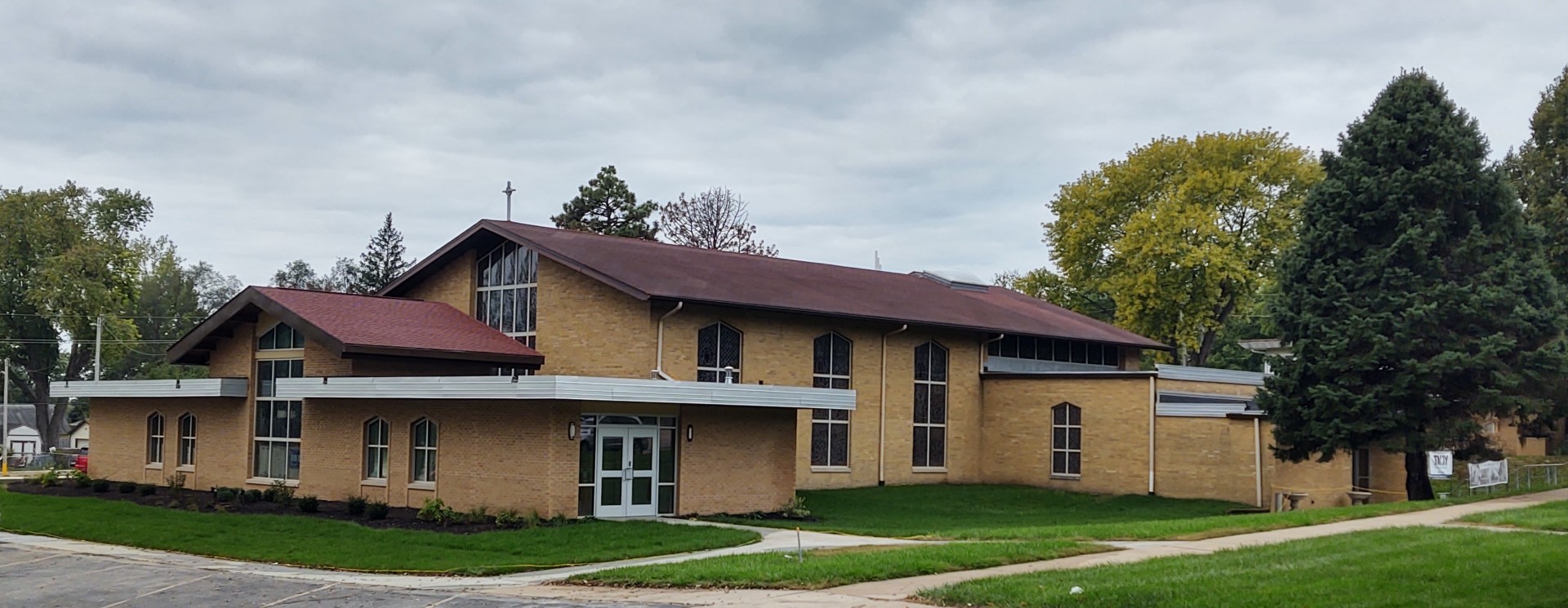
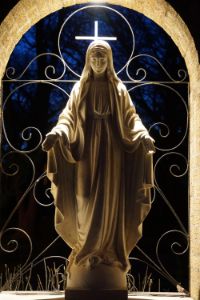
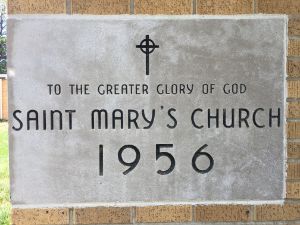
The original church built in 1933 was also quickly becoming too small for the growing parish and by 1956, the cornerstone for the new St. Mary's Church was laid. The first Mass was offered in the new church on Palm Sunday, 1957. The shrine "Our Lady of the Runways" was donated by the Gerard Ianacone family and erected by the Kouba family in 1954.
 The faculty of the school grew and in 1956, an addition was made to the convent to accommodate the increased number of Dominican sisters. By 1959, Sr. Mary Cecile was principal and there were 450 students and 12 teachers, including 8 Dominican sisters. The pastor, Fr. Robert Garvey and his assistant, Fr. Anthony Milone taught religion to the students in grades 1 through 8. The 12 classrooms were spread around the grounds with four classrooms in the original school building, four in the Marian Addition, one in the convent, two in St. Mark's Hall, and one in the church basement.
A new rectory for the priests began being built in September 1958 and was completed in March 1959. In the summer of 1959, a large community room was added to the convent.
The parish and school continued to grow rapidly and by 1960, there were 514 students enrolled. The student to teacher ratio was about 43 students to every teacher. With the increasing enrollment, it was imperative that new rooms be added. In 1962, the Pope John XXIII Addition was completed. This additional space allowed room for up to 750 students and consisted of five new classrooms, the principal’s office, library, teacher’s lounge, and two storage facilities.
The 1960's and 1970's saw frequent changes in pastors and principals, along with the development of new programs for St. Mary's School.
In the 1990s, we added a new gym and revitalized the old basement to include a computer room and library.
Since the 1990s, most of our modernization has gone to digital infrastructure to include fiber optic internet, high speed wifi in every classroom, two portable sets of laptops for in-classroom use, a rebuilt and replaced (multiple times) computer room, digital projectors for every class, and training for the staff.
In the late 1990s, we were blessed to have a strong community of parents who saw that the Parish finances were not enough for the requirements of a modern school and began our Home and School Association. With a series of annual fund raisers like our auction, fireworks stand, coupons, and more, they have raised over a million dollars for the school from the mid 1990s to the present.
We began to develop our alumni and the alumni attitude in our 7th and 8th graders in the 2000s. This is to assure a spiritual, academic, and financial future for our school as we want our graduates to take ownership of the school that provided them with such a strong educational background. We continue to promote this mindset to this day.
In 2019, the school underwent an infrastructure remake to include new ceilings, completely replaced electrical systems, a new fire sprinkler system, new digital LED automatic classroom lighting systems, digital environmental controls for every classroom, new bathrooms, and new flooring. The new controls allow a healthier, more comfortable learning environment that has lower utility expenses.
Pastors and Associates Pastors
| Pastors | Associate Pastors | Pastors | Associate Pastors | |
| Mark L. Ballou (1921-1922) | Thomas Ward (1989-1998) | |||
| Nicholas Zabalza (1922-1924) | Dan Keller (1990-1991) | |||
| Francis Werthman (1924-1927) | Tom Sorenson (1997) | |||
| Edward J. McCarthy (1927-1933) | Jerry Connealy (1992-1993) | |||
| Richard Ahern (1933-1942) | Steve Boes (1993-1994) | |||
| Ernest G. Graham (1942-1945) | Dan Wittrock (1994-1997) | |||
| Robert A. Garvey (1945-1969) | Frank Lordeman (1998-2004) | |||
| Anthony Milone (1958-1963) | Mike Keating (1997-2001) | |||
| John Krejci (1963-1966) | Tim Podraza (2000-2004) | |||
| Thomas Adams (1966-1969) | ||||
| William Martin (1969-1978) | Dennis Hanneman (2004-2016) | |||
| Allen Martin | Dan Andrews (2004-2005) | |||
| Harold Brahm (1971-1976) | Mark Bridgeman (2005-2014) | |||
| Paul Begley (1974-1978) | Roger Kalscheuer (2014-2016) | |||
| Ralph Lammers (1978-1987) | Del Lape (2016-present) | |||
| Richard Swolek (1978-1987) | Roger Kalscheuer (2016-2019) | |||
| Blaise Cupich (1987-1989) | Matthew Gutowski (2019-2021) | |||
| Jerry Connealy (1987-1990) | James de Anda (2022-2023) | |||
| Joe Kwasau (2023-Present) |
Detailed Early History of St. Mary’s from the First Fur Trader to the 1940s
In 1848, Bellevue saw its first Catholic priest on the 31st of May when the steamboat "Wilmington" halted its upward Missouri progress so that Father DeSmet, the famous Jesuit missionary, could go ashore and give the Last Sacraments to a dying employee of the local fur trading company. But the history of our community goes back even further to 1805 when Manuel Lisa, the Spanish trader climbed the bluffs above Bellevue, and looking east and south over river and woods, softly exclaimed, “La Belle Vue” (the beautiful view – in French, the language of fur trappers in the Nebraska region at that time).
"Belle Vue'' or not, the community received no settlers until 1823 when Andrew Dripps, a Pennsylvania Irishman, established a post for the Missouri Fur Company on the river bank about a mile north of the present Bellevue. Andrew was an Irishman, but the majority of his fellow-citizens were French Catholics from New Orleans and St. Louis, and for all accounts (they were traders and trappers), merry fellows.
Lucien Fontenelle, who had been baptized in the Old Cathedral in New Orleans in 1803, came to Bellevue in 1826 and went into partnership with Mr. Dripps. Five years later, the trading post was sold to the government as headquarters for the Indian Agent, John Dougherty, while Mr. Dougherty's brother, who rejoiced in the magnificent name of Hannibal Dougherty, filled the position of Sub-Agent.
The establishment of another trading post, the American Fur Company, brought Peter Sarpy to Bellevue in 1823. Sarpy, after whom Sarpy County is named, was an adventurous member of an old St. Louis Catholic family. In Bellevue, he married Meumbaunee, daughter of the Indian Chief Big Elk, last full-blooded chief of the Omaha tribe, and after her death, he married Nicorni, "Voice of the Waters," a woman of the Iowa tribe.
Distinguished foreign visitors were rare at Bellevue in those days, we may suppose, but it was John Dougherty's privilege to receive Prussian Royalty in the person of Prince Maximillian of Wied, traveling for adventure and health. A "civic reception" was arranged for the Prince and Lucien Fontenelle went out to meet him in his canoe, going to Weeping Water Creek, south of the Platte, and returning with the Prince on the latter's boat, the "Yellowstone". The Prince seemed to have enjoyed his stay at Bellevue very much. He went out to see the Otoes, who had their camp some twenty-five miles to the southwest of Bellevue, as well as the Omahas, who were in the more immediate neighborhood to the northwest. The Prince referred to Bellevue as "Mr. Dougherty’s Post", which consisted mostly of a "few huts and the agent's houses." The men "for the most part, are married to women of the tribes of the Otoes and the Omahas”. The departure of Prince Maximillian left the little village to slumber in inertia until the arrival of Father DeSmet, five years later.
When Father DeSmet was first called to Bellevue, he was traveling in response to a delegation of Pottawattamie Indians who had gone from Council Bluffs to St. Louis a short time before and wanted to invite the "Blackrobes" among them. Father DeSmet had come from Belgium in a sailing boat, and yet he was able to say: "I would rather cross the ocean than ascend the Missouri River." But souls for Christ meant more to him than anything, and he came up from St. Louis, assisted by Jesuit brothers and another priest. The Chieftain of the Pottawattamies, William Caldwell, a half-breed, received him kindly, while the military commander, Colonel Kearney, placed an abandoned fort at his disposal. There he said Mass and taught the Indians, until he built himself a small church which he dedicated to St. Joseph.
During the following months, Father DeSmet visited points on both sides of the River. In July and September, we find him in Bellevue, according to the baptismal records now in the Jesuit archives in St. Louis. In January of 1839, he baptized the five children of Lucien Fontenelle, the eldest of whom was Logan. The youngest girl, Josephine, died in 1932 in western Nebraska. In the same year, on August 18th, Joseph Opetanga, the son of the Omaha Chief, Big Elk, and a boy of seventeen, was baptized.
In November of 1840, on his return journey from Oregon where he had gone to visit the Flatheads, Father DeSmet stopped at Bellevue and took the two oldest Fontenelle lads, Logan and Albert, with him back to St. Louis, where he had them placed in a Jesuit school. Returning from his second trip to Oregon in 1842, he again visited Bellevue. Lucien Fontenelle, whose marriage with Neumbaunee, the daughter of Big Elk, he had blessed in 1839, and whose children he had baptized, was dying. Father DeSmet administered the Last Sacraments, and a few days later, conducted the funeral services at the hilltop grave overlooking the river.
On a subsequent journey from his western mission in 1846, Father DeSmet spent three days with his friends in Bellevue. It was during this visit that he baptized Big Elk, the aged Indian Chieftain. The old man died of fever within a month and was buried on what has since been known as Elk Hill, overlooking Bellevue and afterwards the site of Bellevue Presbyterian College. Logan Fontenelle became Chieftain; Father DeSmet said of him: "Logan succeeded his grandfather and made himself liked and respected by all his nations, both by his bravery and his vision.”
That same year the Mormons reached Traders Point and received hospitality from Peter Sarpy. Father DeSmet, returning from one of his countless missionary journeys to the West told of the Utah Valley, where they settled the following year. Father DeSmet tells us there were ten thousand of them; they spent the late autumn in "Mormon Hollow" above Bellevue, and then moved on to Florence for winter quarters.
Peter Sarpy was in complete charge of the Bellevue Trading Post since the death of his partner, Lucien Fontenelle. He became fast friends with the Jesuit missionary, Father Hoecken, who was visiting the trading posts along the upper Missouri since the abandonment of his mission to the Pottawattamies. In 1816, Father Hoecken baptized Emilie Fontenelle and Logan Fontenelle's wife, Depehe, a member of the Omaha tribe. At the same time, he baptized several Catholic children so, apparently, there was a considerable Catholic population in the area. Father Augustine Ravoux from St. Paul, who had visited the Mormons and then went on to Bellevue, remarked that there were at least forty Catholic families in the vicinity. Omaha, of course, had not yet come into existence.
We find Father DeSmet again in Bellevue in 1848 on his way from St. Louis to the West. He stayed at Sarpy's post, from which he worked westward among the Ponca Indians and other tribes in western Nebraska. Father Hoecken was back, two years later. According to the records he left, he baptized "a great number of the children of the Omaha tribe.” The Omahas at this time had moved nearer to Bellevue, settling about four miles to the west on Papillion Creek. Father Hoecken praised the young chief, Logan Fontenelle, whom he called "a spiritual child of Father DeSmet's” and adds, "He is very worthy of the part he fills in his tribe, and will do all in his power to convert his people and bring them to the true Faith.”
Another outstanding Catholic family in Bellevue at this time was that of Joseph LaFlesche's. Mr. LaFlesche married Peter Sarpy's stepdaughter, and their first child, Louis, was baptized by Father Hoecken. Mr. LaFlesche is said to have been “a very bright Christian gentleman who took much interest in his people." He was commonly known as "Iron Eye”, and was quite popular with the Indians. The Omahas actually, at one time, intended to give him the Chieftainship.
Father DeSmet and Hoecken accepted the invitation of the government to participate in the Great Indian Council, being held at Laramie in 1851. They had not gotten far when both of them were stricken with cholera. Father DeSmet recovered, but Father Hoecken went to his reward after fifteen years among the Indians. His body was interred in the Jesuit cemetery at Florrisant, while Bellevue mourned its dead friend. He was only forty-three. Father DeSmet lived for another twenty years, traveling into even wider fields throughout the West until his death in 1874. During these years, from time to time, he had the opportunity of visiting his beloved missions on the upper Missouri. Some of them disappeared in the course of time; others had been merged into larger missions. All changed with the changing face of America, and the coming of the whiteman in greater numbers.
This was the decade of covered wagons, stage coaches, and river transportation in the Mid-West as it awaited the arrival of the railroads. Twenty-three regular boats, elaborately equipped and decorated, plied on the upper Missouri. The long forgotten town of St. Mary's, on the opposite side of Bellevue in Iowa, was an important point on the trade routes that earned the gold seekers and the pioneers into the West respect. St. Mary's stood on the stage road from St. Joseph to Council Bluffs and Peter Sarpy obtained an exclusive license to run ferry boats and a steamboat across the river. The town today is but a marshy wilderness of brush, but it was then a thriving settlement, rivaling Bellevue as the meeting point for many roads. Travelers from the East and West crossed the river at Bellevue on Peter Sarpy's ferries, and the community was as nationally known as a transfer point as Omaha is today.
In 1854, Peter Sarpy and Stephen Decatur laid out the site of the new Bellevue, about a mile south of the old trading post, hoping that the settlement would grow into a thriving city. Frustrations arose as efforts were made to establish the capital of the state at Bellevue, and many interesting stories can be told of nearly-successful attempts and eleventh-hour maneuvers to obtain the coveted prize. But Sarpy's dream never came true. First Omaha, and then Lincoln became the capital. The Omaha tribe, which had lived in the vicinity of Bellevue, was moved to the Indian Reservation in Thurston county, and there perished Logan Fontenelle, the promising Chieftain and DeSmet's "spiritual child" in an attack by the Sioux. His body was brought to Bellevue, and he was interred by the bones of his father on a hillside north of Bellevue on the 1st of July, 1855. Bellevue's dreams of glory were never restored. With the coming of the Union Pacific and the building of the Council Bluffs Bridge, Omaha became the trade center of the Missouri. At the same time, the river at Bellevue changed its course and threw a part of old St. Mary's into the stream, transferring the rest of it into Sarpy County. The old landmarks were cut for firewood, and now the days of Bellevue's early greatness are but a memory.
The territory that Father DeSmet evangelized has been divided into dioceses and parishes with the advent of his successors and the growth of the Church in the Mid-West. The Catholic story of Bellevue became a part of the history of the Parishes of St. Mary's and St. Agnes' in South Omaha. These parishes stretched southwards to the Platte River, and hence their pastors looked after the spiritual welfare of the scattered Catholic families who continued to live there.
The Catholic activities of the district continued to be largely inactive until the founding of the present St. Mary's Parish in 1921 by the beloved Archbishop Harty, and the establishment of the Columban Fathers in Bellevue the following year. During the building of St. Columban's, a number of Indian skeletons were unearthed, recalling the glory days of Father DeSmet and Father Hoecken. Bellevue waited many years for its Catholic renaissance, but the establishment of the Parish set the cornerstone, and the dedication of the new church in 1933 by Bishop Rummell, the seal of which is capped now by the latest offering of the people and friends of St. Mary's "to the Greater Glory of God” the beautiful new St. Mary's School and Convent.
Source: of this article: Information from Saint Mary's Bellevue · Dedication of the New Parish School 29 August, 1948.
“Suffer the little children to come unto Me and forbid them not, for such is the Kingdom of Heaven.” (Mat. IX, 12)
The New Saint Mary’s
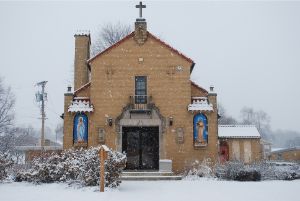
St. Mary's of Bellevue was officially established by the Bishop of Omaha, Archbishop Jeremiah J. Harty on the 25th of April, 1921. Little did the two pioneer founders of Bellevue, Peter Sarpy and Stephen Decatur, visualize that their little hamlet would ever expand to a city of some five thousand souls (in 1921), or that it would ever possess a beautiful Catholic Church, and yet in the Providence of God, both came to be. Archbishop Harty realized that the spiritual needs of Bellevue, hitherto attended to by the clergy of Papillion and St. Agnes of South Omaha, were expanding. Thus the parish received its first pastor, Father Mark Ballou. His territory was to include Bellevue, Fort Crook, LaPlatte, Avery, and Gillmore, large bounds indeed for a parish.
Father Ballou was succeeded shortly after by Father Nicholas Zabalza, an Augustinian friar from Holy Ghost Parish in Omaha, but the work of building the new house of God was not at all interrupted. Two and a half thousand dollars had been spent for the acquisition of ground for the parish, and expenditures the first year of construction totaled over seven thousand dollars. The parish was not even two years old when the debt was reduced by three thousand dollars, although this is by no means a large accomplishment in the financially insecure days of the early 20s.
In 1924, Father Francis Werthman came to the parish as its pastor, remaining for three years and reducing the debt substantially, though this entailed some reduction in the size of the parish land. God was visibly favoring His Bellevue parish, and yet in these early years, it was not able to support a resident priest. Father Werthman boarded at St. Joseph's Hospital where he was also Chaplain and commuted back and forth to his parish from there. Eventually such zeal proved too much for Father Werthman's health.
In March of 1927, Bishop Beckman, who was administering to the Diocese, committed the parish to the direction of the Columban Fathers, and the Very Rev. E. J. McCarthy was named Acting Pastor. Father McCarthy conducted his parish with prudence and success; when he commenced his work, he had exactly fifteen families on whom he could count on for regular support, with a few more added at Christmas and Easter. He disregarded all obstacles, determined to stop at nothing until Bellevue had a House of God worthy of it. It was Father McCarthy who devised the plans for the beautiful Mission-style church, charming in its Spanish austerity. St. Mary's owes a great debt to Father McCarthy.
On July 14, 1933 Father Richard Ahern became pastor at Bellevue and a few days later, oversaw the laying of the cornerstone, with all the beautiful, age-old rites of the Church. The name of the church, formerly St. Mark's, was changed to St. Mary's at this time. This was done to honor the Queen of Heaven and thank her for all she had done for the parish, to revive the memory of the old St. Mary's of pioneer days, and to honor the two famous Jesuit missionaries who had once labored in Bellevue, Fathers DeSmet and Hoecken, both of whom had Mary in their names.
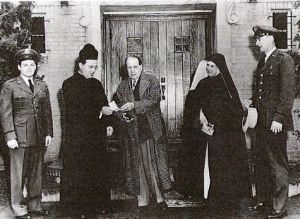 Christmas of 1933 will forever be a memorable day in the Parish's history. The Mass of the Nativity was solemnly sung as the first Mass in the new church! The parishioners congratulated themselves; no longer would it be necessary to offer the Divine Sacrifice in the Knights of Columbus Service Club at Fort Crook. All were united in predicting a marvelous spiritual and material growth for St. Mary's and all predictions had come true.
For nine years Father Ahern labored successfully among the people of Bellevue
until Archbishop Ryan appointed Father Ernest Graham pastor in 1942. Father Graham commenced work with his customary energy, expanding the annual lawn social to
greater proportions. St. Mary's was painted and redecorated, and the beautiful, white-oak liturgical altar was installed and blessed.
Within the ordered calm of St. Mary's, all was peaceful and serene, but war was soon to engulf this quiet community. Bellevue's geographical location in the center of the United States had aroused the interest of Washington D.C. The peaceful Nebraskan community was ideal for defense purposes; it was equally distant from both coasts, and the patriotism of its citizens was unquestionable, so it soon became a beehive of activity. Bull-dozers and scoops tore their ways through hills and prairies, and ribbons of concrete stretched out in all directions. From Illinois and Iowa, Missouri and the Dakotas came skilled mechanics to assemble the great steel monsters, the B-29's, and Bellevue found itself with a national reputation for aircraft construction.
No longer could the community consider itself a haven of rest. Bellevue was playing a war role that exceeded in importance the activities of many larger cities, and her citizens did not forget it. For three years they lived the life of the shift. Nights turned into days, and days into nights as Bellevue armed the Nation.
Five hundred houses were erected by the Federal Housing Administration, and two smaller settlements of a hundred homes, Martinview and Airview, sprang up even closer to the great Bomber Plant.
St. Mary's saw many busy days, administering to Her new children. The church was able to be placed on a much sounder foundation, due to generous donations from the high wages of the war-working parishioners, and all looked forward to the great building days that awaited the end of the War.
Pastors in other sections of the country were obliged to complain that their war-workers did not take their spiritual or moral duties to their parish very seriously, but no such reproach was ever leveled at the people of St. Mary's. What they had, they gave - and gladly. They cherished the faith of their fathers, appreciated their beautiful church, and sensed instinctively that it was a privilege to maintain and embellish the House of God.
It was with deep regret and sadness that the parishioners saw Father Graham take leave of St. Mary's. His faithfulness and zeal had won him recognition throughout the Archdiocese, and in March 1945, Archbishop Ryan summoned him to the important post of Rectorship of the Metropolitan Cathedral. Father Graham left behind him seven thousand dollars in the building fund for St. Mary's, but he took with him the esteem and reverence of the whole Parish, and when he was further honored by the purple robes of a Domestic Prelate in 1947, there was no happier a group than the members of his old parish.
After an interregnum of three months during which time the good Columban Fathers again cared for the parish, Father Robert A. Garvey was appointed as Administrator of St. Mary's Parish. He came at a difficult time for St. Mary's. V-E Day had arrived, and Bellevue had come to resemble a town of the fabulous Gold Rush Days. Long lines stood outside the post office, awaiting notice of plant layoff, while the highways were clogged with trailers, departing in all directions. Bellevue had grown rapidly, and she was destined to disperse even more rapidly. "For Sale" signs and vacant houses were of an abundance, and there were those who declared that the community had outlived its usefulness and was destined to become only a ghost town.
But the months sped by, and lawns that had become unkempt and houses that had been allowed to fall into disrepair returned to their former neatness. Then came V-J Day in 1946, and once more Bellevue appeared to be heading for a slump. Fortunately, it never came. Fort Crook was deactivated from its century-old function as an Infantry Post and the Second Air Corps took possession of its heavy duty runways. Glenn Martin's Bomber Plant 's immense structures and houses were once more at a premium as soldiers and airman flocked to Bellevue.
New houses were built, for renting was impossible in these difficult days, and even the purchase of homes was a hardship with their prices doubling overnight. G.I. loans facilitated somewhat the purchase of homes for young couples, but this assistance did little to create a "permanence mentality" in the community. Bellevue was suffering from acute "movitis” but its parish had permanent plans to stay afloat!
Towards the latter part of 1945, twenty-five representative men of the parish met with the Pastor to discuss providing for the Catholic education of the children of the parish, the number of which was rapidly increasing. The possibility of purchasing the Government Health Center was discussed with the idea of remodeling it into school and chapel, but the total price would have involved thirty thousand dollars and the site was rather inconvenient, so the idea was ultimately abandoned.
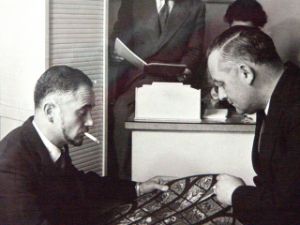 But the question of a school was not allowed to be abandoned. A School Drive was inaugurated early in 1946; each family was asked to contribute to the fund, and Architect Leo A. Daly who already had St. Mary's Church to his credit was selected with the approval of the Most Reverend Archbishop to design the new school and began to draw his plans. The structure was to be in harmonizing Mission-style to the Church, and was to consist of four spacious classrooms, one of which was to be used as a Chapel; a large gymnasium-auditorium with locker room and community kitchen; and finally a complete convent with living quarters for four sisters. The initial cost had been considered a generous $35,000, but St. Mary's was laboring under the trial of the post-war years. Costs soared to $75,000, a dreadful sum for a parish the size of St. Mary's, but their faith in God never wavered. A loan for $40,000 was obtained, and with the invocation of God's blessing, ground was broken for the new structure on September 14, 1947. The new building sat considerably higher than the Church, for the school had been given ten lots, the parish had purchased two more, and now was in possession of an entire square block of property with a wonderful view that extended for miles in every direction.
Actual construction began early in 1948. The Abstractor of Titles had made a serious mistake when filling out the legal documents, and it became necessary to obtain a waiver of building restrictions from fifty homes in the Rushart Addition. The reception
accorded the men who carried out this unpleasant task of explaining this to the neighbors was most gratifying; the majority of the occupants were not of the Catholic faith, and it greatly helped everyone's morale to see how willing and ready they were to assist their Catholic brethren.
Construction work continued on the school, and 150 concrete piers were sunk six feet deep to provide a solid foundation against the old river bed that had once flowed under the school. The Men's Club of St. Mary's solidly backed the new building project and gave unselfishly of their time and energy to collect the necessary funds.
The brunt of the actual work of drawing plans and making financial arrangements fell on the shoulders of two Committees - the Building and the Finance. These men, several of them professional engineers, were responsible in a large degree for the beautiful structure that is the St. Mary’s of today.
Nor were the ladies of St. Mary's inactive during this time. A very efficient group, organized as the St. Mary's Altar Society, promoted numerous social affairs to provide income for the school. The Annual Lawn Social and Chicken Dinner, held on the Feast of the Assumption for many years, had been a fruitful source of revenue to the Parish. Many Omaha friends arrived in Bellevue on that day to attend the Parish festivities, much jollity occurred, and all enjoyed themselves immensely.
During the course of 1945 and 1946 several improvements were made in the Church. A complete set of liturgical vestments in all colors were made by the Benedictine sisters of Yankton, South Dakota and were donated to St. Mary's by the generosity of several of the parishioners. Two new wood carvings of St. Mary and St. Joseph were also donated by families in memory of their departed members. Florescent lighting was installed in the sanctuary and new lights in the body of the Church were installed to beautify and embellish the House of God. And last but not least the sanctuary furniture was completed in light oak of the same design and pattern as the altar. In October 1947, the parish purchased the rectory for the sum of $7,000 with a mortgage of approximately $3,000.
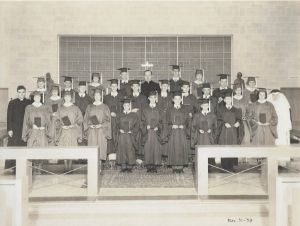 The blessing of the new school had been set for August 29th, 1948. It was a happy and significant day for Bellevue; happy at a job well done, significant in the growth of the community. St. Mary's gave thanks for the safe return of Her sons and daughters from the War, and remembered affectionately on this day her heroes who did not return; She will remember with warm thoughts the thousands of war-workers who entered her doors, and have now departed elsewhere, carrying their precious Catholicity with them; She will remember with thanks the kind Omahas, many of them non-Catholic, who contributed seven thousand dollars to her building fund, Mr. E.C. Wescott, the efficient contractor, her former Pastors, living and dead, and the Good Columban Fathers who sowed the seeds of faith that are now being reaped so well. Especially will She thank the three Dominican Sisters, Sister Rosalia, Sister Joan Michael, and Sister Joan Miriam, who at great sacrifice made the journey from St. Catherine, Kentucky to rear the Parish children in the way of justice and truth--the parish is superlatively fortunate to obtain these esteemed Sisters.
Finally, we were sincerely grateful for the many favors and constant protection of our Heavenly Queen--may She continue to watch over and bless Saint Mary's!
Early History Written in 1948 – Author Unknown – Found in Parish Files