Welcome to St. Mary's and the unique faith-filled beauty captured in our stained glass windows!
As a Catholic community, our hope is that these windows will be a source of inspiration, meditation, and reflection. We invite you to bask in their beauty and peace as you strengthen your relationship with Jesus Christ through celebration of the Mass, the Holy Rosary, and perpetual adoration devotion.
St. Mary's beautiful stained glass windows are filled with stories of our faith and reflections into our parish's history. Father Robert Garvey, pastor when the church was first built in 1956, had high standards to offer his community and fellow followers of Christ. He saw the windows as an opportunity to share a message of discipleship for generations to come who would worship in this space.
Father Garvey was St. Mary's pastor for over 25 years. The Rault brothers of Rennes, France designed the windows. Between 1948 and 1990, the Rault studio of Rennes (Brittany) created original suites of windows for nearly one hundred churches, cathedrals, and chapels in seven Canadian provinces and eight American states. St. Mary’s Church in Bellevue, Nebraska is among those for which stained glass was created during that time. The windows were acquired through Burns-Hanley Company in Saskatchewan, Canada. St. Mary’s unique stained glass windows, original to the church, are valued at over $1.7 million dollars.
“These windows are a large part of our parish identity, and we have an obligation to maintain them so they will be here into our next century of faith.” - Reverend Lydell Lape
We will be celebrating our next century of faith Sunday, April 25, 2021. In preparation, the windows have been cleaned, repaired, and restored and new protective outer glass has been installed. We are blessed with a community that supports our efforts.
Our Faith in Stained Glass
The use of mosaic designs in most stained glass windows came about due to the availability of glass in ancient times being only in small pieces. Eventually, this evolved into the birth of pictures on glass in great Cathedrals to help the people learn about the biblical stories and as an aid in their meditation and prayer at church.
The Gothic cathedral represented the universe in microcosm. Each architectural concept, including the loftiness and huge dimensions of the structure, was intended to convey a theological message: the Great Glory of God.
At the end of the 18th and beginning of the 19th centuries, faith in God was making a resurgence as an anchor of hope for many people. As faith surged, it called for a material expression of its history and beauty.
All over Europe, leaders found the artists, the architects, and other craftsmen with the enthusiasm, talent, and spirit needed to revive an art form specifically for depicting the faith in all its glory. This art form - stained glass windows – could not have fit this purpose more perfectly.
-
St. Mary's Stained Glass Windows
Mary and the Saints - Main Section
Our Holy Mother Mary and several Saints are depicted on the large windows in the main body of the church. Each window has a message full of thought-provoking wisdom that can instill in your prayer life a desire to work toward a closer union with God through their example. More information on them can be found below.
16 Clerestory Windows - North and South Sections
Mary, our church’s namesake, is honored in the 16 clerestory windows on either side of the sanctuary. More information on them can be found below. Each window represents one of the titles given to Mary in the Litany of Loreto. This Litany can be found at the end of the descriptions of the stained glass windows.

The Holy Family at the Nativity - Facade Window
The Archangel Gabriel stands holding the Star of the East, the Nativity Star, and is flanked by the Holy Family. St. Joseph is to the left and Mary to the right. Beneath the trio, the Christ Child rests in the manger. All elements of the Christmas story are present in this magnificent window.
To the left of St. Joseph, the trumpets symbolize the call of the angels to the shepherds whose sheep of varying colors are depicted in the scene below. Likewise, the grapes and pomegranates in the drapery above and below the trumpets make the connection of Christ to the Eucharist. To the right of Mary, parallel to the trumpets, are the three crowns which represent the Three Kings who likewise followed the star. Beneath the crowns, the jar of burning incense represents their homage to the Newborn King.

Baptism of Jesus - Narthex Window
Originally, this window was featured in the church's confessional room. However, during construction of the new Narthex in 2020-2021, the window was moved from its original position hidden away in the confessional and is now displayed in its spot of honor as the front window of the Narthex.
St. John the Baptist is shown baptizing Jesus in the Jordan River. Luxurious palm trees and foliage frame the scene, above which the Dove of the Holy Spirit hovers. To the left are two stags coming to drink from the fount of the waters of life. To the right is a peacock, the symbol of eternal life in Christ.

Mary, Queen of the Holy Rosary
Mary, "Queen of the Holy Rosary," stands on a bed of roses. Beneath her feet is the black and white shield which bears the crest of St. Dominic, founder of the Dominican Order. Tradition holds that Mary gave St. Dominic the Rosary in a vision in 1214. This shield is also a reference to the Dominican Sisters who first staffed St. Mary’s School. The window also depicts the Mysteries of the Rosary. The Star of the Nativity and the Lamb of God born in the stable represent the Joyful Mysteries. The Crown of Thorns encircling the nails of the crucifixion represents the Sorrowful Mysteries. Lastly, the Lily or Fleur de Lis surrounded by the five stars (the Five Wounds of Christ) represents the Glorious Mysteries. Note also, the lily is surrounded by the wings of a dove, often used to depict a soul's release to heaven.
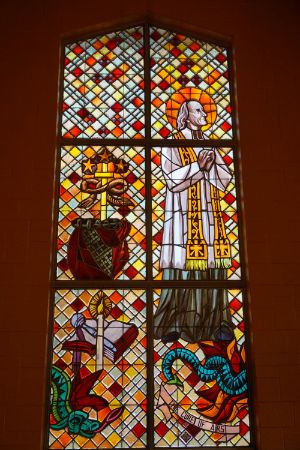
St. John Marie Vianney, Cure of Ars
St. John Marie Vianney, "Cure of Ars,'' is the patron saint of priests and was known as a powerful confessor. People from all over Europe traveled to his small church in Ars, France to receive the sacrament of confession from St. John Vianney. His body is incorrupt and is visible at his parish church. Symbols of the Saint depicted in the window include the cross and stole with three stars above it. This is a symbol of the priest acting "in persona Christi," in the person of Christ, during the sacrament of confession. Below this is the traditional screen of the confessional.
In the bottom panel, the Bible, candle, and holy water sprinkler are represented - all attributes of the Saint. He is depicted standing on a serpent, a reference to the thwarted attacks made on his person by the devil.
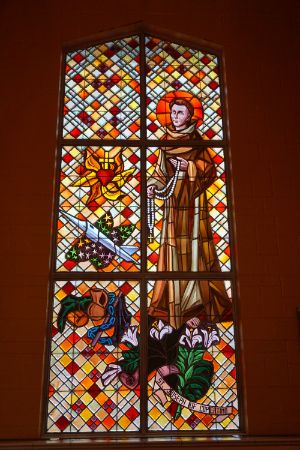
St. Joseph of Cupertino, Patron of Pilots
St. Joseph of Cupertino, Italy is the patron saint of pilots. Therefore, it is no surprise that local members of the Air Force donated this window. St. Joseph was a Franciscan monk whose great love of God showed itself in his supernatural ability to fly. This ability to levitate thus explains his connection to those who fly. The saint is depicted in the traditional Franciscan robe holding a rosary and standing on a bed of lilies. Other symbols in the window include a heart with cross surrounded by flames representing St. Joseph's ecstatic love for God. Below, an airplane pays homage to his role as patron of pilots and is a nod to the generous donors. Lastly, the jar and loaf represent the Eucharist and are surrounded by objects of self- mortification: thorns, chains, and the cat o' nine tail.
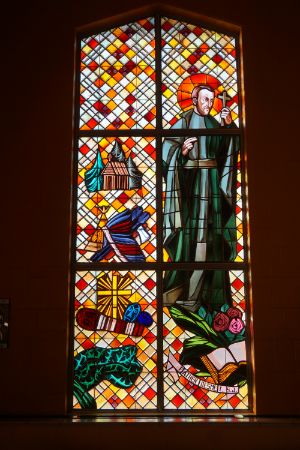
Father Pierre-Jean DeSmet
This famed Jesuit missionary to the Native Americans, both here in Bellevue and in the Pacific Northwest, is depicted with roses and a Bible at his feet. After the American Fur Company's establishment of St. Mary's Landing (originally on the Iowa side until the river changed), Fr. DeSmet made several visits to Bellevue on his trips up and down the Missouri. In 1839, he baptized Omaha tribal Chief Logan Fontenelle.
Various symbols of Fr. DeSmet's work are depicted in the window including the mission church in the pines representing his work in Idaho and Oregon. The teepee, arrows, and headdress stand for his Bellevue mission work amongst the plains tribes. The cross above the masks represents Fr. DeSmet's work among the Flatheads and Nez Perce of the Pacific Northwest. The thorns in the lower left unify the window with all the others and recall the deep reason behind Fr. DeSmet's travels: to unite his own sufferings with Christ and to tirelessly bring Christ to the expanding West.
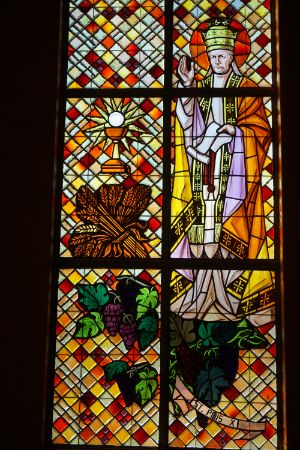
St. Pius X
This window is dedicated in honor of St. Mary's Perpetual Adoration, established in 1953. St. Pius, long a proponent of this devotion, is depicted in his papal attire, including the triple crown tiara. He holds the Decree of Frequent Communion of 1904, which established age seven as the earliest age for reception of the sacrament. Fittingly enough, St. Pius stands on a cluster of grapes and grape leaves. Symbols of the saint are therefore Eucharistic in nature: the Chalice and Host in the above left and the shocks of bundled wheat beneath. It is interesting to note, that St. Pius X was canonized on May 29, 1954, just two years prior to the laying of the cornerstone of the new St. Mary's Church.
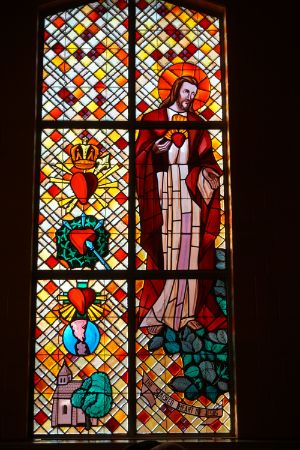
The Sacred Heart of Jesus
Christ first appeared to St. Margaret Mary in 1673. After several apparitions to this Visitation nun in the small French village of Paray-le-monial, she established the devotion to the Sacred Heart of Jesus. Christ's words to her were those of protest: "Behold the heart which has loved men so much and in return is loved so Iittle." St. Mary's pastor, Fr. Robert Garvey visited Paray-le-monial in 1950 prior to the parish's establishment of Perpetual Adoration in 1953. There he experienced the holy hour Jesus had asked St. Margaret Mary to observe each month from 11:00-12:00pm the Thursday before First Friday. Witnessing the packed chapel, the devotion, and the mass at midnight, Fr. Garvey returned to his small parish with renewed enthusiasm about Perpetual Adoration.
The four symbols in the window, including the figure of Jesus, are the triumphant heart with its crown and scepter, the suffering heart encircled by the crown of thorns and pierced with the lance and nails, and the universal heart (symbolizing love for all men) shown on the cross anchored to the earth. Beneath these symbols is the chapel of Paray- le- monial.
-
Holy House of Loreto
The Holy House of Loreto is one of the most revered Marian shrines in the world. A large basilica has been built around the small shrine, and the sacred site attracts as many as four million Catholic pilgrims and visitors each year. Since medieval times, the Holy House has been believed to be the very home in which the Virgin Mary lived, conceived, and raised the young Jesus.
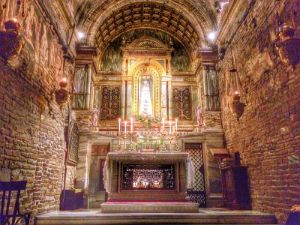 According to the New Testament, Jesus was raised by Mary and Joseph in a small town called Nazareth. Joseph was a carpenter, and their house was humble. Three centuries after the life of Jesus, the newly-converted Emperor Constantine built a basilica over the humble brick house that was believed to have sheltered the Holy Family.
Catholic tradition states that the Holy House came under threat during the turmoil of the Crusades. So, in 1291, angels miraculously transported the house from its original location to a site in modern-day Croatia. The bewildered parish priest, brought to the scene by shepherds who discovered it, had a vision in which the Virgin Mary revealed it was her former house. On December 10, 1294, the house was again moved by angels due to the unrest of the Muslim invasion of Albania. It landed first in Recanti, Italy, but was shortly thereafter moved for a third time to its present location in Loreto.
The Holy House of Loreto, or Santa Casa di Loreto in Italian, has been venerated by pilgrims and numerous miracles and healings have been reported on its premises. Scientists are said to have confirmed the materials to be the same as those found in Nazareth. Many historians, Catholics included, are not entirely convinced. One common hypothesis about the origin of the Marian shrine of Loreto is that a miraculous statue of the Virgin was brought from Croatia to Loreto and placed in a humble abode that came to be venerated as well. Another possibility is that crusaders or monks brought a house, or parts of it, from the Holy Land.
In 1469, a large basilica was built over the Holy House at Loreto, and still stands today. In 1510, the site was officially approved for pilgrimages. The Basilica sheltering the Holy House has been rebuilt and repaired periodically since its construction in 1469, leaving it with a Renaissance exterior and a Gothic interior. Inside the basilica, the Holy House is, of course, the main attraction.
It is a small stone building measuring 13 x 31 feet, with traces of medieval murals on the inner walls. On the east wall (not part of the original building) is an altar with the Latin inscription Hic Verbum Caro Factum Est, "Here the Word was made flesh." A statue of the Virgin stands above the altar.
-
Clerestory Windows
The following pictures of the sixteen clerestory windows located to the right and left of the altar at St. Mary’s are united in theme, they represent Mary, the Mother of God, in titles given her in the Litany of Loreto:
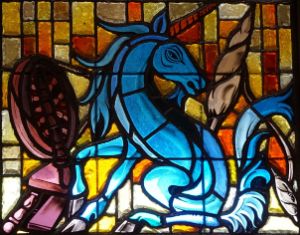
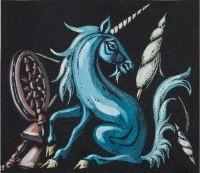
Mother Most Chaste
Legend has it that the only way to catch a unicorn was for a virgin to be alone in the forest. The unicorn would then come and lay its head upon the virgin's lap. Thus, the unicorn came to symbolize Christ, "Whom the Heavens could not contain" but who nonetheless humbled Himself to be born of a virgin. In direct opposition to Mary's "Yes," is Eve, represented by the spinner's wheel and raw wool.
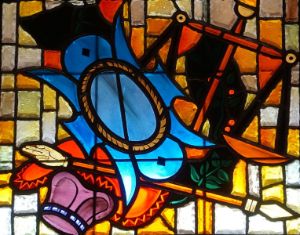
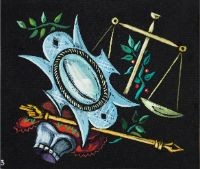
Mirror of Justice
In the context of the Litany, justice refers to Mary being "just" or pure and unstained by original sin. While Mary, the first disciple, completely reflects Jesus, we struggle with sin. Therefore, by our actions, we choose to align our scales with Mary's scepter points: blessing (the hand in benediction) or death (the spear).
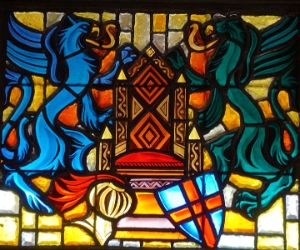
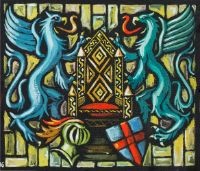
Seat of Wisdom
A pair of griffins holds up Mary's royal throne. The griffin, a creature who has the body of a lion and the head of an eagle, has long been a symbol of the Incarnation and the dual nature of Christ. How does Christ become man? By being born of a woman, Mary. Beneath the throne, the ornate jar and the shield emblazoned with the cross likewise provide reference to other symbols of Mary from the Litany of Loreto: Mary, Vessel of Honor and Mary, Refuge of Sinners.
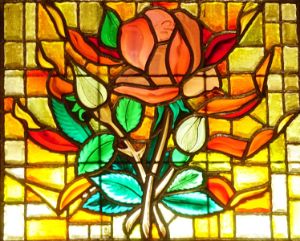
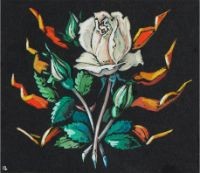
Mystical Rose
Mary is symbolized by a rose with thorns (sorrows), green leaves (a symbol of hope), and bloom (virginal purity and freedom from sin).
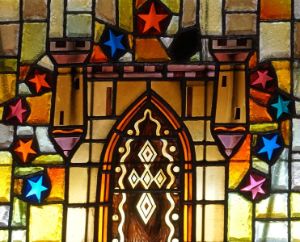
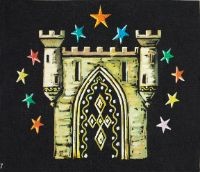
Tower of Ivory
The tower portrayed in this window is encircled with ten stars. Along with being a reference to the Litany of Loreto, it also references the biblical Song of Solomon 7:5 "Your neck like a tower of ivory."
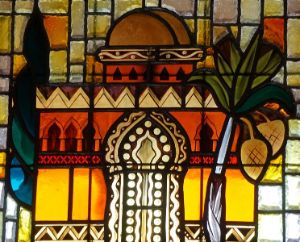
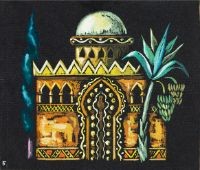
House of Gold
Gold is a symbol of purity due to the fact that it is a refined metal. King Solomon built a temple to house the Ark of the Covenant and thusly, "nothing in the temple was not covered with gold" (l Kings 6:22).
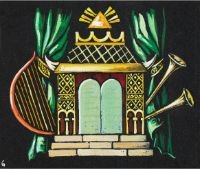
Ark of the Covenant
The Ark of the Covenant is a symbol of God's promise to Israel being fulfilled in the personage of Jesus Christ. The Ark itself is described in Exodus 25. Used as a repository for the Old Testament Covenant (10 Commandments), The Ark is a parallel to Mary, the New Ark of the Covenant, who bore Jesus, the New Testament Covenant. Likewise, the lyre and trumpets resound with joy at this fulfillment.
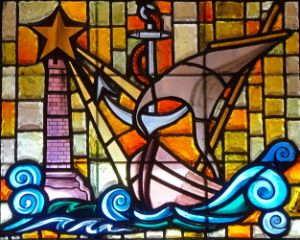
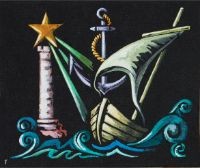
Star of the Sea
The Hebrew name for Mary is Miriam, which means "star." Mary, represented by the star on a column of strength, shines her rays upon the storm-tossed ship. The ship is the Church as it touches the lives of those the world over. The anchor symbolizes hope, true hope in Jesus Christ.
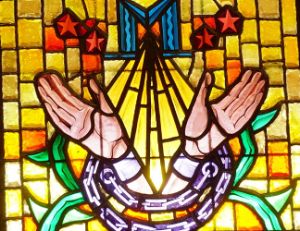
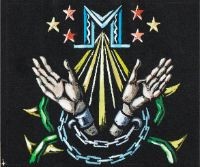
Comforter of the Afflicted
Rays of comfort flow from Mary, Our Mother, symbolized here by her monogram and stars. Chained to sin, the hands are raised in the orans, or praying position, and pleading for Mary's intercession. Likewise, the thorns of daily life surround the afflicted, thus calling the faithful to unite their suffering to Christ's.
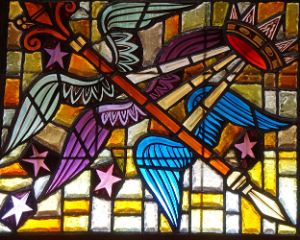
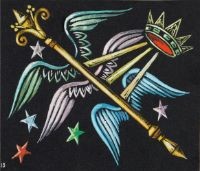
Queen of Angels
Mary's crown and scepter rule over the three orders of angels, represented by three sets of wings. Each order, in turn, consists of three choirs of angels.
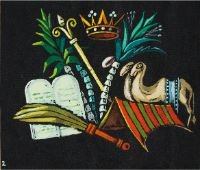
Queen of the Patriarchs
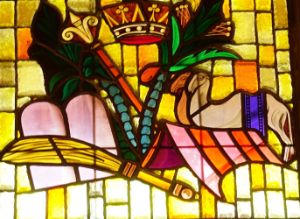
The God of the Patriarchs is the God of Mary. Mary is symbolized by the crown and scepter with the fleur de lis. The tent and camels represent Abraham, Father of the Jewish faith, whereas the two tablets and taskmaster's whip refer to Moses. The palm tree and lotus refer to the time spent by not only Mary, but especially Moses, in Egypt.

Queen of Prophets
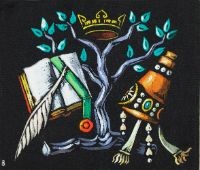
The Old Testament prophets are represented by the quill and book and the Jewish priestly mitre, or turban. The tree itself recalls the story of Jesse from the Book of lsaiah. Mary herself is descended from this line and is represented by the crown.
Queen of the Apostles
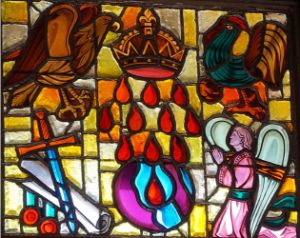
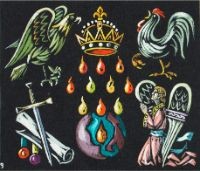
The Marian crown hovers above the earth and eleven tongues of fire, thus signifying Mary's role as the first apostle. Likewise, in each corner of the window, there is an additional symbol of Mary. In the upper left hand corner is the eagle, a reference to John the Apostle. In the upper right is the rooster, which, in its darker meaning, symbolizes Peter's denial of Christ. Nonetheless, the rooster also symbolizes hope in that its crow signals the beginning of a new day.
Queen of the Martyrs
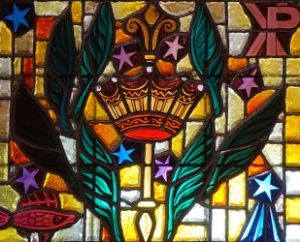
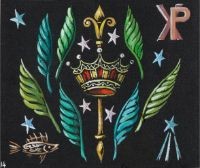
Palm branches, symbols of martyrdom, surround Mary's crown and scepter. Stars provide courage and strength to those afflicted with such an end. In the upper right hand corner is the Chi Rho, or Greek symbol for Christ, from whom Mary ultimately receives her strength. In the lower left, is the fish, the early Christian symbol for Jesus.
Queen of the Most Holy Rosary
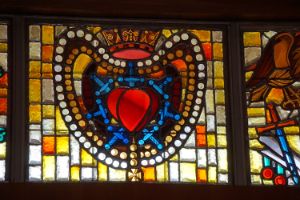
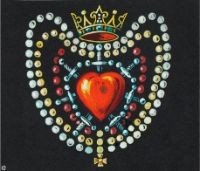
Mary's crown is enthroned above three rosaries. These refer to the Sorrowful (red), Joyful (brown), and Glorious (white) mysteries. In the center is the Heart of Mary, pierced by seven swords representing the Seven Sorrows of Mary
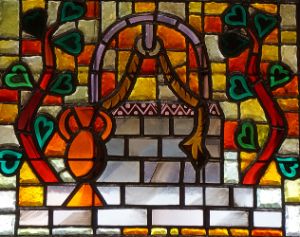
Fount of Life
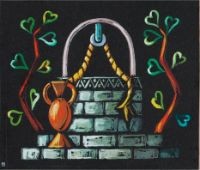
The central focus of this window is the well into which the empty vessel is lowered and the Waters of New Life are brought forth. Mary, through her "Yes" (Fiat), allowed herself to be filled with the Holy Spirit and thus brought forth Christ. The end result: New Life in Christ, as the flowering vines themselves attest.
-
Litany of Loreto
(Highlighted are the pictured titles given Mary in the Litany that we have in our church. Note: Fount of Life is not in this Litany, but is a title pictured in the stained glass windows.)
Lord, have mercy.
Christ have mercy
Lord have mercy. Christ hear us
Christ graciously hear us.God, the Father of Heaven, have mercy on us.
God the Son, Redeemer of the world, have mercy on us.
God the Holy Spirit, have mercy on us.
Holy Trinity, one God, have mercy on us.Holy Mary, pray for us.
Holy Mother of God, pray for us.
Holy Virgin of Virgins, [. . .]Mother of Christ,
Mother of divine grace,
Mother most pure,
Mother most chaste,
Mother inviolate,
Mother undefiled,
Mother most amiable,
Mother most admirable,
Mother of good counsel,
Mother of our Creator,
Mother of our Savior,Virgin most prudent,
Virgin most venerable,
Virgin most renowned,
Virgin most powerful,
Virgin most merciful,
Virgin most faithful,Mirror of justice,
Seat of wisdom,
Cause of our joy,
Spiritual vessel,
Vessel of honor,
Singular vessel of devotion,Mystical rose,
Tower of David,
Tower of ivory,
House of gold,
Ark of the Covenant,
Gate of Heaven,Morning star,
Health of the sick,
Refuge of sinners,
Comforter of the afflicted,
Help of Christians,Queen of Angels,
Queen of Patriarchs,
Queen of Prophets,
Queen of Apostles,
Queen of Martyrs,
Queen of Confessors,
Queen of Virgins,
Queen of all Saints,
Queen conceived without original sin,
Queen assumed into Heaven,
Queen of the Most Holy Rosary,
Queen of families,
Queen of peace,Lamb of God, Who takest away the sins of the world,
Spare us, 0 Lord.Lamb of God, Who takest away the sins of the world,
Graciously hear us, 0 Lord.Lamb of God, Who takest away the sins of the world,
Have mercy on us.Pray for us, O Holy Mother of God.
That we may be made worthy of the promises of Christ.Let us pray. Grant, we beseech Thee, O Lord God, that we thy servants may enjoy perpetual health of mind and body, and by the glorious intercession of blessed Mary, ever Virgin, may we be freed from present sorrow, and rejoice in eternal happiness, through Christ our Lord.
Amen.
-
Maquettes - Parish Center
Maquettes of each window are framed and hung in the Church Parish Center. They are made from the original “maquettes,” or blueprints, from the Rault brothers that were used to make each of the stained glass windows in the church. Upon completion, the maquettes were sent back to the parish as keepsakes. Though they were the guide for the finished windows, additions and changes were made as Fr. Garvey directed the Rault brothers upon his viewing of their plans.
After observing that the maquettes did not include some important symbolic details in the windows, Mary Jane Tweedy decided her 2016 Lenten Project would be to compile the history behind St. Mary's stained glass windows. We are so appreciative of her efforts.
The maquettes pictured here were the blueprints from which the windows were made:
-
The Rault Brothers
André Rault (1912-1997) and his brother Paul (1909-1962) are considered the master artists of a family that has been producing stained glass in Rennes since the late 1800’s with the firm of Lecomte et Coline, which they acquired at that time.
In the 1920s and 30s, like many other French glass artists, André and Paul became fascinated by a breakthrough technical innovation known as, dalle de verre (called “slab” or “faceted” glass in America.) The new material led the Rault brothers to experiment with its endless decorative possibilities. The slabs created with this new technology were cut into chunks whose edges were chipped with silversmiths’ hammers to create the effect of raw jewels, enlivened by random tiny bubbles and streaks of color.
Dalle, set in conventional lead cames (channels), became a unique characteristic of Rault installations, adding a three-dimensional element to what had always been a two-dimensional medium. The Rault brothers insisted on using lead cames, allowing the faceted edges to reveal their radiance and refracting the maximum amount light possible. When backlit by sunlight, the radiance of their dalle compositions are ravishing.
It is so amazing to see how the windows’ beauty changes at St. Mary’s throughout the day and with the changing of seasons. To be there sitting in the pew as you watch the rays of the sun light up the gold in Mary and Jesus’s crowns in the Façade window, is truly a wonderful experience. What a gift the Rault brothers brought to St. Mary’s!
Their style often manifests a fusion of medieval religious imagery with modern feeling, incorporating the deep textures of the ancient stained glass masters with a 20th century directness and a freshness that was sometimes lost in the elaborate styles of the 19th century.
Elements of 20th-century art movements such as Expressionism, Modernism, and Art Deco are frequent in their work; their decorative motifs and symbol details are more likely to suggest Henri Matisse than William Morris. In addition to the figurative works often demanded by clients, they also created semi-abstract and non-figurative designs. Their modern interpretations of medieval Christian symbolism are especially charming.
As the European churches regained their pre-war composure in the late 1940s, the Raults looked abroad for new clients. Canada presented an opportunity. In Western Canada, Burns- Hanley Church Supplies of Regina, Saskatchewan represented Rault Freres, as the company was known at that time. Every year, from 1948 to 1977, André RauIt would travel to the West to meet with potential clients in churches and convents; they would subsequently be sent beautifully colored maquettes of proposed designs.
Eventually, over 60 large and small installations were completed in the West, primarily in Saskatchewan and Alberta, as well as in British Columbia, Washington State, Minnesota, Montana, and the Dakotas. Small cathedrals in Whitehorse, Yukon, and Yellowknife, NWT have the most northerly Rault work anywhere. Notable installations include Holy Rosary Cathedral and Blessed Sacrament Church in Regina, Cathedral of the Assumption in Gravelbourg, St. Joseph's Seminary in Edmonton, and three St. Patrick's churches in Medicine Hat, Lethbridge, and Edmonton, Alberta. There are ensembles in Omaha, NE and Spokane, Washington and a large installation at St. Paul, Minnesota. The Rault tradition continues in Rennes under André's son Frédèric as Les Maîtres- Verriers Rennais, now the longest continuously operating stained glass studio in France.
Patrick Burns of Burns-Hanley Church Supplies
Regina, Saskatchewan
Excerpts copied from Vitraux d'Art E.Rault
www.glassincanada.org/news/vitraux-dart-e-rault/
The information contained here was acquired and compiled through research of St. Mary's Catholic Church's archives and internet resources.
Special Mentions:
The description of the windows comes from Patricia Kusek's "History of St. Mary's Parish" found in St. Mary's archives.
Pictured "Maquettes": Property of St. Mary's Church and located in the Parish Center. They were framed for the Parish by Larry Gold.
Photography: Becky Feagan
- 1